
The vocational school students have strong knowledge of the various themes of sustainable development
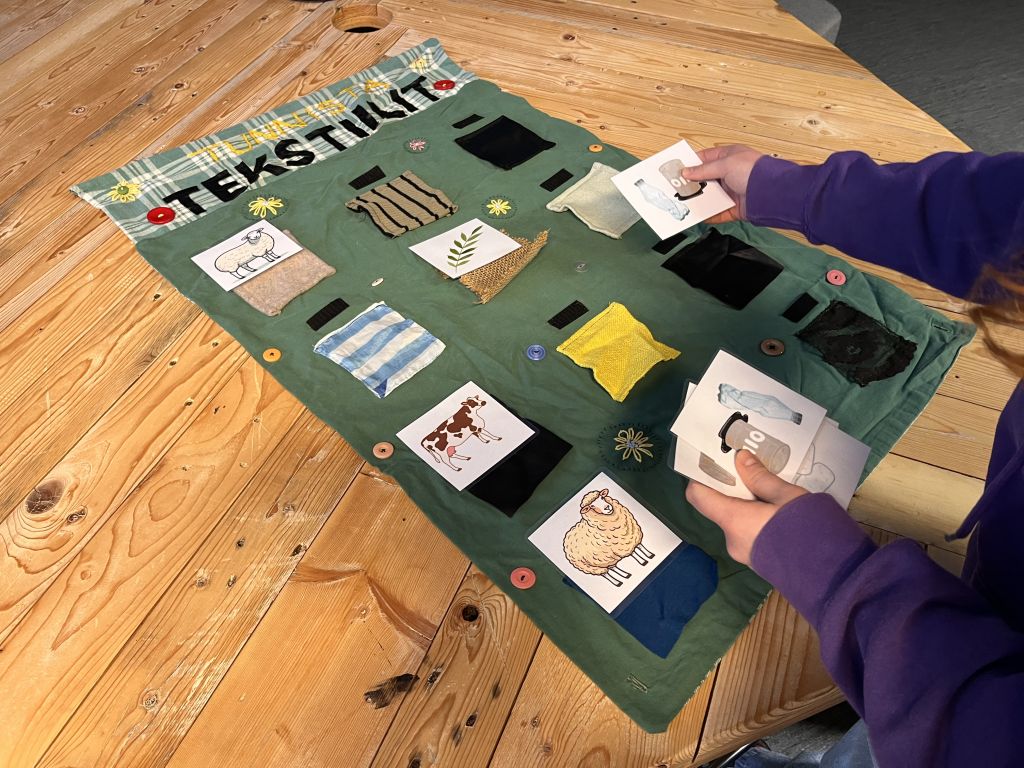

Are young people interested in learning about sustainable development? What kind of learning goals does the vocational school set for young people in terms of sustainable development themes?
We, the student trainees of the Baltic2Hand project, were offered the opportunity to give a circular economy themed lesson on the sustainable development course of practical nursing students at the Turku Vocational Institute. Could we inspire these young people and, on the other hand, could we learn something from them?
The idea of a circular economy themed lesson for practical nurse students originally started when a teacher from the Turku Vocational Institute approached the representatives of the Baltic2Hand project at the Turku University of Applied Sciences stand at the Fix repair festival held in Hansakortteli Turku in September. At the Fix repair festival stand, a game designed by student trainees was in use.The game is part of Messusalkku, a concept developed by the student trainees of the Baltic2hand project, which includes participatory games related to sustainability and circular economy. Messusalkku is designed to be used in various events, and we were able to test and develop it again in this assignment.
In the end, the assignment was very open, and we were able to let the inspiration take us. In the end, we started the task with a presumption: young people are likely to be inspired to learn through activating games. We wanted to be able to test the Messusalkku, and this is how the idea of various educational control points was born, which the students could complete in groups.
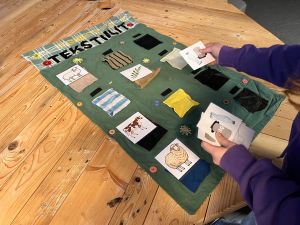
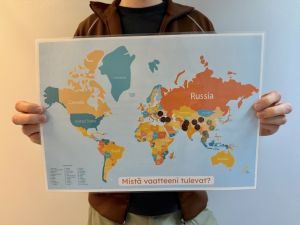
Two of the games were already part of the Messusalkku and had previously been tested out at various events: the identification of textile materials (Pic 1.) and material circulation. As new games, we developed a sustainable development Alias and a map in which you can point out where do your clothes come from. These can be used in Messusalkku later.
During the control points, we quickly noticed something delightful: the vocational school students already had a surprisingly strong background knowledge of the various themes of sustainable development and circular economy. In addition to the games, we also had a moment to talk to these young people and hear their thoughts. One of the points dealt with the product’s life cycle from circular economy point of view, and the students’ critical thinking was highlighted nicely. The mistake in the correct answers was immediately noticed, and it was jointly stated in the discussion that sustainable design begins even before the selection of raw materials for the product.
We, the student trainees, found this visit inspiring, but also useful for the Baltic2Hand project. We were able to try out the Messusalkku, and found it was useful in the educational environment. The young student’s activity in the games and discussion made this kind of visit inspiring, and it was nice to be able to participate as a leader too. So, in conclusion, we can say that such collaborations will be possible and interesting in the future as well.
Oona Kaarmela ja Joona Saine
student trainees
Turku UAS
The article was written as part of the Baltic2Hand project, which promotes the reuse of textiles and reduces textile waste by creating new business models for operators of second-hand clothing. The project involves the circular economy business models research group of Turku University of Applied Sciences. The Baltic2Hand project has been funded by Interreg Central Baltic 2021-2027 and partly with the support of the European Union.